
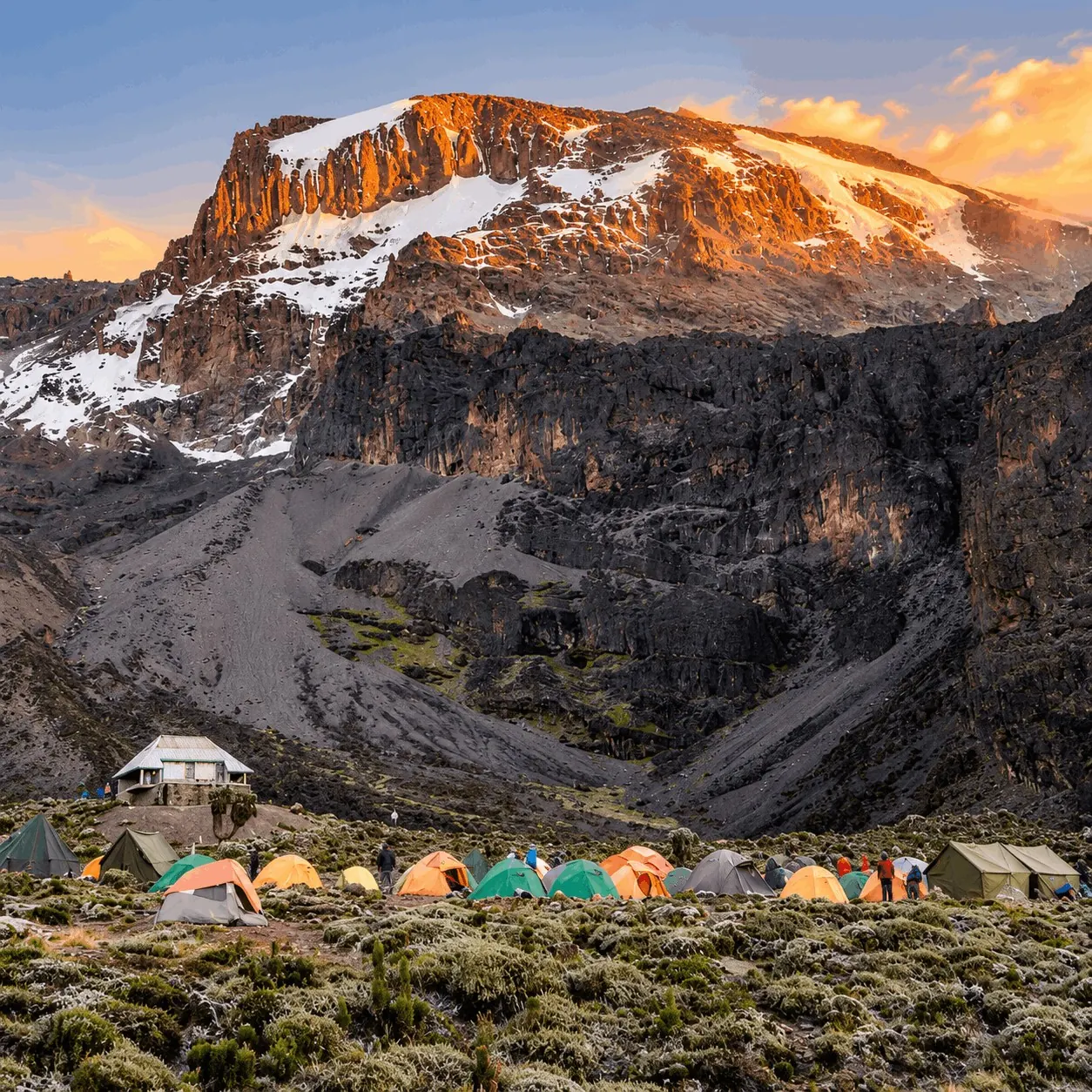
Lemosho Route
Kilimanjaro · group departure
Seven days from the quiet western forest across the full width of the Shira Plateau, then along the southern circuit to the summit. More time to acclimatise than Machame.
- Duration
- 7 days on the mountainhotel nights in Moshi optional
- Highest point
- 5,895 mUhuru Peak
- Distance
- 49 km up20 km down
- Start
- Lemosho Gate2,100 m, west side
- Level
- AcclimatisationChallenging (3/5)PhysicalChallenging (3/5)
Why choose Lemosho
Lemosho approaches Kilimanjaro from the west, through forest where you meet few other groups. Three days take you across the Shira Plateau before the route joins Machame at the Lava Tower. The extra day compared with Machame gives your body more time to adjust.
It suits travellers who want a gradual ascent and varied scenery and can take eight days. In seven days the route is also possible, with less time on the plateau.
Route & altitude profile
Altitude along the route, to scale by distance. Acclimatisation hikes are not drawn.
7 days
Day by day
7 days on the mountain. The date of a group departure is the first trekking day. Hotel nights in Moshi before and after the climb are not included in the price; we can book them for you.
Day 1Trekking from Lemosho Gate to Mti Mkubwa Camp2,100 → 2,650 m
Whether you arrive at Kilimanjaro International Airport (JRO) or Arusha Airport (ARK), or are already staying in Arusha or Moshi, a Stunning Kilimanjaro representative will meet you, after which you will travel by vehicle (roughly 3-4 hours) to Kilimanjaro National Park's western entrance: Lemosho Gate (2,100 m).
After the quick formality of acquiring climbing permits and registering with the search and rescue service, the group will start trekking towards the first camp of the route: Mti Mkubwa Camp (2,650 m). Raincoats are necessary on this day in particular, as you will be walking through rainforest. By the time you reach the camp, our mountain crew will already have put up all the tents and cooked a hot dinner for you.
- Lemosho Gate 2,100 m → Mti Mkubwa Camp 2,650 m
- 7 km
- 3–4 hours
Day 2Trekking from Mti Mkubwa Camp to Shira I Camp2,650 → 3,850 m
After an early wake-up and breakfast, you trek gradually upwards. At around 3,610 m you get your first views of the Shira Plateau and Kibo. The stage from Mti Mkubwa Camp to Shira I Camp (3,610 m) is fairly easy and takes about 4-5 hours, after which you can spend the rest of the day acclimatising in camp or taking a stroll in the surrounding area.
- Mti Mkubwa Camp 2,650 m → Shira I Camp 3,610 m
- 7 km
- 4–5 hours
Trekking from Shira I Camp to Shira II Camp
After breakfast, you'll leave Shira I Camp (3,610 m) and continue your gradual ascent towards Shira II Camp (3,850 m). This part of the route has wide views over the volcanic landscape, with its rolling moorland and distant peaks. Along the way, you may spot unique high-altitude flora and, on clear days, see Kibo and Mount Meru in the distance. Upon reaching Shira II Camp, you can relax in your tent or take a short walk around the area to further aid acclimatisation. As evening approaches, your team of specialists will cook you dinner and you will be able to rest for the night.
- Shira I Camp 3,610 m → Shira II Camp 3,850 m
- 10 km
- 4–5 hours
Day 3Trekking from Shira II Camp to the Lava Tower3,850 → 4,600 → 3,900 m
After breakfast you will leave Shira II Camp (3,850 m) and start your way to the key point of the route: Lava Tower (4,600 m).
This section of the route has a lot of ascents and descents that lead up to Lava Tower at 4,600 metres. It might be difficult, and you may feel some discomfort, but to acclimatise properly you have to spend at least 1-2 hours here, so this is where lunch will be.
Note: If one or more participants feel sick, the group may refrain from passing the Lava Tower and adjust the route, following the porters' route instead. In that case you will not reach the full altitude of Lava Tower, only a maximum of about 4,400 metres.
- Shira II Camp 3,850 m → Lava Tower 4,600 m
- 7 km
- 3–4 hours
Descending to Barranco Camp
Then you will descend to Barranco Camp (3,900 m). Here you can see the famous Barranco Wall, impressive in both its massive size and steepness! Tomorrow you will climb it, but don't worry: the hiking trail is straightforward.
- Lava Tower 4,600 m → Barranco Camp 3,900 m
- 3 km
- 1–2 hours
Day 4The Great Barranco Wall3,900 → 4,202 → 3,995 m
In the morning, after an early breakfast, you take on the Great Barranco Wall (4,202 m), a nearly vertical rock face that requires some scrambling. We recommend you leave the camp as early as possible to avoid crowds of the other groups.
Although hiking up the gorge wall may look intimidating, it is not difficult and only takes around an hour. After the climb you can have a rest and take photos in front of the Kibo volcano.
After a short break, descend to Karanga Camp (3,995 m) for lunch.
- Barranco Camp 3,900 m → Barranco Wall 4,202 m → Karanga Camp 3,995 m
- 6 km
- 4–5 hours
Acclimatisation Hike towards Barafu Camp
After reaching the camp you will be offered a warm lunch, and after a couple of hours, you will set off on an acclimatisation hike in the direction of Barafu Camp with a 300-metre gain in altitude, and then descend back down to Karanga Camp (3,995 m).
Note: An acclimatisation hike is an easy trek with a slight gain in altitude done in order to speed up the acclimatisation process. You should take the acclimatisation hikes very seriously. They help increase your chances of successfully summiting Kilimanjaro and saving you from the consequences of altitude sickness.
- Karanga Camp 3,995 m → highest point 4,270 m → Karanga Camp 3,995 m
- 2.5 km
- 1–2 hours
Day 5Trekking from Karanga Camp to Barafu Camp3,995 → 4,673 m
In the morning after breakfast you begin your way to Barafu Summit Camp (4,673 m), the starting point for your night-time summit attempt on Uhuru Peak (5,895 m). Our team will set up a camp for you ahead of time, including tents and sleeping bags, so you can relax.
- Karanga Camp 3,995 m → Barafu Camp 4,673 m
- 4 km
- 4–5 hours
Acclimatisation Hike towards Kosovo Summit Camp
After regaining strength, you have to complete an acclimatisation hike towards the intermediate Kosovo Summit Camp (4,800 m) and then back to Barafu Camp, where you will be served a hot dinner. It is better to spend the remainder of the day resting and sleeping before night summiting.
- Barafu Camp 4,673 m → highest point 4,800 m → Barafu Camp 4,673 m
- 2 km
- 1–2 hours
Day 6Summit Attempt to Uhuru Peak (5,895 m)4,673 → 5,895 → 3,100 m
Departure from Barafu Camp (4,673 m) at night and the start of summiting Kilimanjaro: Uhuru Peak (5,895 m), passing Stella Point (5,756 m) along the way.
Technically the climb is relatively simple; however, the most challenging part is the high altitude. Each pair of climbers will get a personal guide for the entire ascent to monitor your physical and mental conditions.
- Barafu Camp 4,673 m → Stella Point 5,756 m → Uhuru Peak 5,895 m
- 5 km
- 5–7 hours
Descending to Mweka Camp
After celebrating your success and taking in the view, you can descend to the nearest glacier if desired. Then you will descend to Barafu Camp (4,673 m) for a rest.
Note: Take care on the descent: the trail is steep and loose in places, and most slips and injuries happen on the way down. Watch your footing, and keep in mind that the downhill is hard on the toes and knees.
After a 2-hour rest you will continue your descent to Mweka Camp (3,100 m).
- Uhuru Peak 5,895 m → Barafu Camp 4,673 m → Mweka Camp 3,100 m
- 10 km
- 6–7 hours (2 hours of rest at Barafu Camp excluded)
Day 7The Last Descent from Mweka Camp to Mweka Gate3,100 → 1,640 m
Mweka Camp sits at the edge of the rainforest. When you wake up, you will feel relief from the lower altitude and the satisfaction of reaching the summit. After a warm breakfast, you will head for the park's exit: Mweka Gate (1,640 m).
- Mweka Camp 3,100 m → Mweka Gate 1,640 m
- 10 km
- 3–4 hours
Congratulations!
After your descent, the whole team gathers to congratulate you. You will be presented with your commemorative certificate, and we would love to hear your feedback on the climb on our online review page. Afterwards you are transferred onwards to your next destination.
Included
- All entrance fees, included government taxes
- All activities (unless indicated as optional)
- All accommodations as mentioned in the itinerary
- Meal plan with 3 meals per day: breakfast, lunch, and dinner
- Unlimited bottled drinking water
- A professional driver and mountain guide
- Transportation to and from the base of the mountain
- Alternative transportation in the event of a breakdown
- Camping equipment
- Porter services
- Official certificates issued by the Kilimanjaro National Park Authority (KINAPA)
Not included
- Tips
- International flights
- Visa for Tanzania
- Local SIM-card
- Medical and/or travel insurance
- Entry insurance, where required for entry into Tanzania or Zanzibar
- Personal expenses, such as souvenirs
- Alcoholic beverages, soft drinks, and meals not specified as included
- Medical evacuation by helicopter
- Park fee or tax increases after booking (see art. 5 of our Terms and Conditions)
Optional
- Extra accommodation before or after the itinerary
- Zanzibar extension, including domestic flights
- Safari extension
Group departure · price per person
From
USD 2,150 per person*
*The starting price is based on a group departure of 6 adult participants in any season, excluding airport transfers and accommodation before and after the trek.
A fixed price per person for a place on one of the dates. Hotel nights in Moshi before and after the climb can be added on request.
Group departures 2027
The date is the first trekking day. Prices are per person and include park fees, full board and a full mountain crew (guides, cook and porters). Hotel nights in Moshi before and after the climb are not included and can be added on request. Subject to availability. Choose a date to request a place.
All group departuresQuestions
More in Safety on Kilimanjaro, Best time to climb and our frequently asked questions.
How fit do I need to be?
A basic level of fitness is enough; no climbing technique is needed. Train for endurance in the months before your trip: long walks, ideally uphill with a daypack. See your doctor before you book, especially with asthma, heart or lung conditions. See Safety on Kilimanjaro.
What happens if I get altitude sickness?
Most climbers notice the altitude: a headache, less appetite or poor sleep. Your guides check on you regularly, encourage you to drink and adjust the pace. Every climb carries oxygen for emergencies. If symptoms get worse, your guide decides that you descend, always accompanied by a crew member: going down is the most effective treatment. See Safety on Kilimanjaro.
Can I add an extra acclimatisation day?
Yes, on every route, for a surcharge. An extra day gives your body more time to adapt to the altitude.
Combine your trip
One trip, put together for you
Every trip can be combined: a Kilimanjaro climb with a safari, Mount Meru before Kilimanjaro, or a few days on Zanzibar to finish. Tell us what you would like to do and we put it together into one itinerary, with the transfers and rest days in the right places.
- Climb + safari
- Safari + Zanzibar
- Meru + Kilimanjaro
Request this route
Plan your Lemosho climb
Send us your preferred dates and group size. We reply personally with a proposal and an exact price.
- WhatsApp or call Tanzania: +255 681 857 105 (English, Swahili)
- Support team in the Netherlands: +31 6 2247 9775 (English, Dutch)