
The Great Migration Safari
Private safari · 10 days
Explore Tarangire National Park, Serengeti National Park, Ikoma Game Reserve, Mto wa Mbu, Lake Manyara National Park and the Ngorongoro Crater and follow the great herds of wildebeests and zebras as they move through the vast plains of the Serengeti and across the Mara River.
- Duration
- 10 days9 nights
- Areas
- 6 areasTarangire, Ngorongoro, Serengeti, Ikoma, Mto wa Mbu, Lake Manyara
- Start and end
- ArushaOr the airport (JRO / ARK)
- Safari type
- PrivatePrivate vehicle and guide
Why this trip
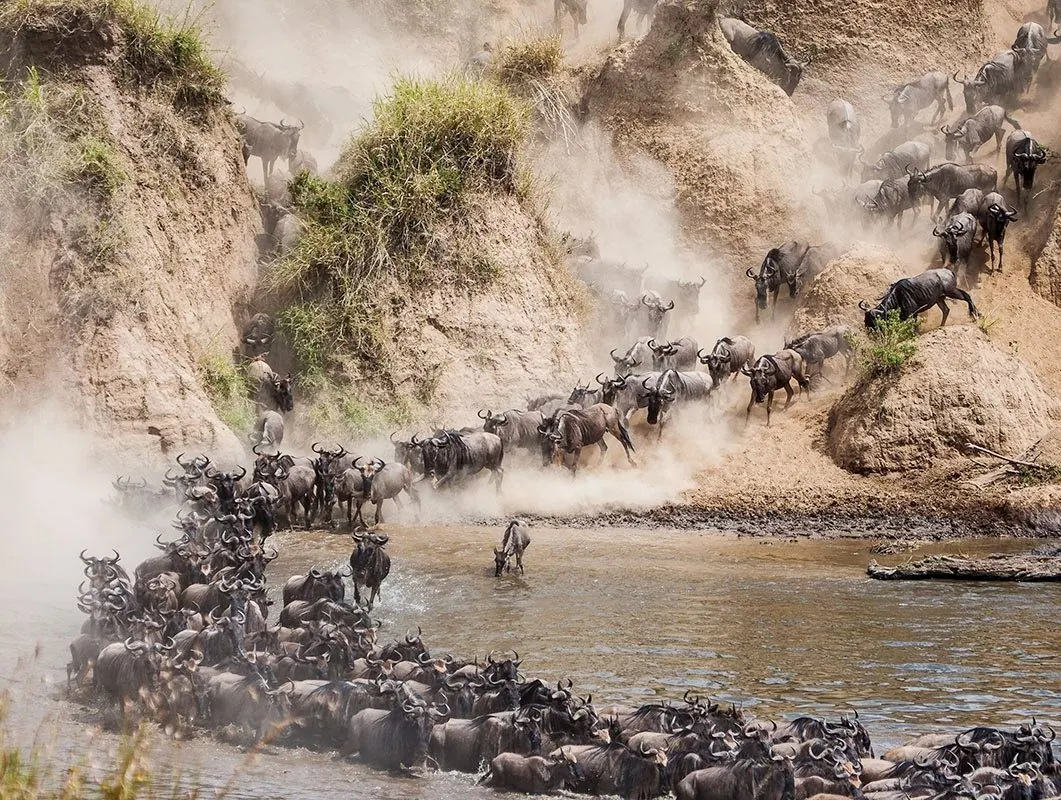
Every year more than a million wildebeest, together with zebras and gazelles, move in a large circle through the Serengeti ecosystem in search of grass and water. Where they are depends on the month: in the south around the turn of the year, in the centre and west in spring, and in the north in the dry season.
Choose seven to eleven days by road, or a fly-in safari of three to five days. For the fly-in, choose your travel period: from June to mid-August the herds are mostly in the west and centre, from mid-August they cross the Mara River in the north.
10 days
Day by day
Day 1The Materuni Waterfall
Whether you arrive at Kilimanjaro International Airport (JRO), Arusha Airport (ARK), or are already staying in Arusha or Moshi, a Stunning Kilimanjaro representative will meet you and escort you to your safari vehicle. From this moment on, your safari adventure begins with a drive to the lush mountain village of Materuni, located at the foot of Mount Kilimanjaro. Upon arrival, you’ll be welcomed by a local guide from the Chagga community, who will accompany you during this tour.
You’ll continue with a gentle hike through banana plantations, coffee fields, and tropical rainforest. Along the way, your guide will share insights into the local flora, fauna, and the daily village life. After about an hour of walking, you will reach the impressive Materuni Waterfall, which plunges into a natural pool below.
Take your time to enjoy the view, the cool mist, and an optional refreshing swim in the clear mountain water.
Coffee Tour & Local Lunch
After the hike, you will return to the village, where you’ll take part in a traditional coffee-making experience. From roasting and grinding beans, which you will do all by yourself, you’ll learn about the age-old techniques of the Chagga people. Accompanied by local songs and dances, you’ll taste your freshly brewed cup of coffee, followed by a warm, homemade lunch featuring local specialties. After lunch, your guide will drive you to your next hotel in the Lake Manyara area, where you’ll have some time to enjoy the African sun at the pool bar, before dinner is served.
Day 2Elephants & Baobabs in Tarangire National Park
In the morning after breakfast your safari continues with a drive to Tarangire National Park.
In this park, you will have the chance to see many wild Tanzanian animals (lions, buffalo, giraffes, zebras, etc.), but it is best known for its large number of elephants, which usually stay close to their water source, the Tarangire River. You should be aware that this is wild nature, so the guide cannot guarantee the presence of specific animals, but you can be sure that they will do their best to find everything you’re looking for. In our experience, a day in Tarangire rarely passes without a sighting to remember.
In the late afternoon your guide will drive you to your accommodation in the Lake Manyara area for dinner and overnight.
Day 3Descending into The Ngorongoro Crater
After breakfast you will head to the rim of the Ngorongoro Crater, where you come across a remarkable viewing point and can take in the view.
Descend into the Ngorongoro Crater for a full day of game drives. The crater floor is home to a wide variety of wildlife. You will have the chance to see buffaloes, elephants, lions, wildebeest, zebras, hippopotamuses and other cat-like species such as caracals and servals. The luckiest travellers might even see a rhinoceros, an animal whose numbers are rapidly declining.
Lunchboxes will be served at a designated picnic spot, near a hippo pool, and during the afternoon you’ll make your way out of the crater and continue to your accommodation in the Lake Ndutu area for dinner and an overnight stay.
Day 4The Migration from South to West
After breakfast you set out for a game drive in Southern and Western Serengeti.
On the wide plains of the south you can see lions and cheetahs from far away, and further on the woodlands and river valleys of the Western Corridor are home to hippos, crocodiles and black-and-white colobus monkeys along the Grumeti River. The herds of the Great Migration move between these areas with the rains, so depending on the time of year you can find them in the south, the west, or somewhere in between. Your guide will follow the latest sightings.
After your game drive you continue to your accommodation in the Ikoma Game Reserve for dinner and overnight.
Day 5The Great Migration in Northern Serengeti
After breakfast you will head northwards through the Serengeti’s remote and less-travelled regions toward the Mara River. It’s optional to have breakfast in the Jeep or within the park, so you can witness the animals in their more active moments.
This area becomes particularly dramatic during the Great Migration when massive herds of wildebeest and zebra cross crocodile-infested waters. You may witness them gathering at the riverbanks, hesitating before the dangerous crossing. Besides these big herds, the area is teeming with resident wildlife such as elephants, giraffes, antelopes, and an impressive variety of birdlife.
After an exciting game drive, you will head back to your accommodation in the Ikoma Game Reserve.
Day 6A Morning in the Ikoma Game Reserve
In the morning, enjoy a half-day game drive in the Ikoma Game Reserve, a protected conservation area bordering the Serengeti. The vast savanna landscape offers excellent opportunities to spot elephants, buffaloes, lions, leopards, hyenas and all sorts of antelopes. In the months of the Great Migration the herds of wildebeest and zebras can pass through the area on their way north, and where they do, the predators are never far behind.
After returning to your accommodation, a warm lunch will be served, followed by some time to relax and rest.
Sunset Walking Safari
In the late afternoon you will depart from your lodge for a walking safari, led by an experienced local guide. Along the way you have the opportunity to learn everything about the wildlife, the flora and fauna, the different kinds of landscape, the culture and the local communities. As the sun slowly sinks, you approach your guide who has driven into the reserve and has set up a spot with chairs and some drinks, where you can watch the sunset together out in the reserve. When you return to your lodge you’ll have dinner and can have a late-night drink at the bonfire, before heading back to your tent.
Day 7Following the Herds Along the Mara River
Today you return to the banks of the Mara River, the heart of the Great Migration in the northern Serengeti. Your guide knows the crossing points and will follow the movements of the herds, which can change from day to day depending on the rains and the condition of the grazing.
Besides wildebeest and zebra, the region is home to lions, cheetahs, hyenas, elephants and giraffes. The river itself is lined with hippos and crocodiles, and the open plains towards the Kenyan border are excellent for spotting predators on the hunt.
Lunch will be served as a picnic at a scenic spot, after which you continue the game drive until the late afternoon, when you return to your accommodation in the northern Serengeti for dinner and overnight.
Day 8A Morning in Northern Serengeti
After breakfast you set out for a half-day game drive along the Mara River in the northern Serengeti, when the light is soft and the animals are most active.
Around midday you have lunch and continue towards the eastern Serengeti, where the afternoon is reserved for a second game drive.
An Afternoon in Eastern Serengeti
In the afternoon you set out on your second half-day game drive of the day, across the open plains of the eastern Serengeti. The light softens as the day cools down, and the plains are a good place to look for lions and cheetahs. In the evening you continue to your accommodation in the Karatu District for dinner and overnight.
Day 9Cultural Tour in Mto wa Mbu
Today you will meet the local inhabitants of Mto wa Mbu, located at the base of the Rift Valley escarpment.
Experience how they provide for themselves, and learn how Tanzania’s lands are farmed and how its products are being processed. You’ll learn about the different uses of bananas and get a chance to try Tanzania’s very own banana beer, a local brewery of the Chagga tribe. Furthermore, you will learn about unique trades and craftsmanship that are only practised by certain tribes in Tanzania, like the wood-carving skills of the Makonde tribe.
The small, busy town of Mto wa Mbu is home to people from many different Tanzanian tribes, who live and work side by side. You’ll visit the local market, where fresh produce, colourful fabrics, and handmade crafts are sold daily. A local guide will then take you on a village walk or bike tour (optional), offering you the chance to see the local working life, local homes, schools, while enjoying nature en route.
A traditional Tanzanian lunch will be served in the village, prepared by local women using fresh ingredients.
In the afternoon, you can choose to relax or continue exploring the surroundings before heading back to your accommodation in the Lake Manyara area, where dinner and overnight stay are arranged.
Day 10Last Safari in Lake Manyara National Park
After breakfast, your guide will head for the entrance of Lake Manyara National Park for a half-day game drive. The park is known for its tree-climbing lions and its birdlife, and a large part of the park consists of water.
It is a densely wooded area, which makes it a challenge to spot animals, but the drive along the forest and the lake is a beautiful way to end your safari.
Airport Transfer
After your game drive at Lake Manyara your guide drives you back to Arusha, a journey of around two hours. Your guide plans the timing around your flight. Upon arrival in the Arusha area, you’ll be dropped off at your hotel or at Kilimanjaro International Airport (JRO) or Arusha Airport (ARK).
Depending on your flight schedule and whether you’re heading for a beach holiday in Zanzibar, this marks the end of your Great Migration Safari Adventure with Stunning Kilimanjaro. We hope you go home with good memories, plenty of photos and a closer bond with the wildlife and landscapes of Tanzania.
Full Board is available as an option. You can also buy your own meals separately.
Included
- All entrance fees, included government taxes
- All activities (unless indicated as optional)
- All accommodations as mentioned in the itinerary
- Meal plan with 3 meals per day: breakfast, lunch, and dinner
- Unlimited bottled drinking water
- A professional driver and wildlife guide, during the safari
- Pick-up and drop-off at the airport
- Transport on 4x4 Land Cruiser with pop-up roof, during the safari
- Alternative transportation in the event of a breakdown
Not included
- Tips
- International flights
- Visa for Tanzania
- Local SIM-card
- Medical and/or travel insurance
- Entry insurance, where required for entry into Tanzania or Zanzibar
- Personal expenses, such as souvenirs
- Alcoholic beverages, soft drinks, and meals not specified as included
- Medical evacuation by helicopter
- Park fee or tax increases after booking (see art. 5 of our Terms and Conditions)
Optional
- Extra accommodation before or after the itinerary
- Zanzibar extension, including domestic flights
- Cultural Maasai village visit
- Hot Air Balloon Safari
Private trip · price per person
From
USD 2,895 per person*
*The starting price is based on a private mid-range tour with 7 adult participants (full vehicle) in high season.
The price per person depends on group size and travel dates. You receive an exact quote in USD for your trip.
Questions
More answers in our frequently asked questions.
Where is the Great Migration and when?
The herds of wildebeest and zebra move through the Serengeti all year. From late January to early March most calves are born on the southern plains; from about July the herds are in the north, near the Mara River. Our Great Migration Safari and Calving Season Safari follow them.
What does a safari day look like?
Most days you explore the parks by vehicle from early morning to late afternoon, often with a picnic lunch in the park. Animals are most active in the cooler early and late hours. Your driver-guide decides with you where to go and how long to stay.
What vehicle do you use, and how many people fit in it?
A Land Cruiser with a pop-up roof, so you can stand up to watch and take photos. A vehicle is fully occupied with seven travellers. On a private safari the vehicle and your driver-guide are only for you and your travel companions.
Where do I stay on safari?
In lodges and tented camps, with three meals a day. Tented camps are proper rooms under canvas, with beds and a private bathroom. We choose the accommodation with you, from budget to luxury, to suit your budget and the kind of trip you want.
What should I wear on safari?
Comfortable clothing in neutral colours such as khaki, beige or olive; avoid bright colours and camouflage. Long sleeves and long trousers protect against sun and insects, and a warm layer is welcome on cool mornings, especially on the Ngorongoro crater rim. Add a hat, sunglasses and comfortable shoes. See the packing list.
Can you change an itinerary or combine trips?
Yes. The itineraries on this website are examples. We adjust the length, the accommodation and the order of the days, and combine a climb with a safari, Zanzibar or Mount Meru into one trip. Tell us what you have in mind via Plan your trip.
Combine your trip
One trip, put together for you
Every trip can be combined: a Kilimanjaro climb with a safari, Mount Meru before Kilimanjaro, or a few days on Zanzibar to finish. Tell us what you would like to do and we put it together into one itinerary, with the transfers and rest days in the right places.
- Climb + safari
- Safari + Zanzibar
- Meru + Kilimanjaro
Request this trip
Plan this trip
Send us your preferred dates and group size. We reply personally with a proposal and an exact price.
- WhatsApp or call Tanzania: +255 681 857 105 (English, Swahili)
- Support team in the Netherlands: +31 6 2247 9775 (English, Dutch)